
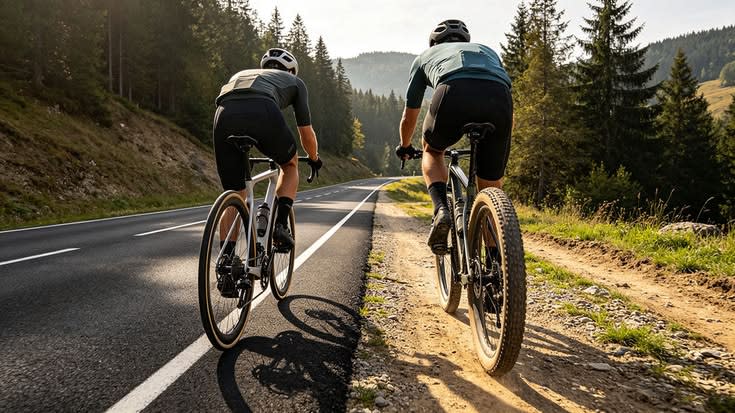
Ten years ago, gravel didn't exist as a category. Today it's the fastest-growing segment in cycling. If you're deciding between a road bike and a gravel bike, the answer depends on what you actually want to do.
The real differences
Tyre clearance. Road bikes accept up to 28–32mm tyres. Gravel bikes accept 40–50mm. Wider tyres = more comfort, more grip, more capability on rough surfaces.
Geometry. Gravel bikes are slightly more upright and stable. Road bikes are lower and more aerodynamic. This affects how you feel after 3 hours, and how the bike handles at speed.
Weight. A gravel bike is 1–2 lbs heavier than an equivalent road bike. Not a big deal unless you're racing.
Gearing. Gravel bikes typically have wider gearing (easier climbing). Road bikes have tighter ratios for smoother cadence at speed.
When road wins
- You ride mostly on paved roads.
- You want speed and efficiency.
- You race or do fast group rides.
- You already have a gravel bike for everything else.
When gravel wins
- Your local roads are rough — patchy asphalt, chip-seal, farm lanes.
- You want one bike that does everything — commuting, touring, bikepacking, gravel racing.
- You value comfort over raw speed.
- You like being able to leave the pavement without worrying.
The honest answer
If you're buying one bike for everything, buy gravel. It'll do 90% of what a road bike does, plus everything else. You'll be 5% slower on pavement and 200% more versatile off it.
If you're buying a second bike and want speed, buy road. You already have the versatile option.
Compatibility notes
- Both use the same pedals, shoes, helmets, and clothing.
- Gravel wheels accept road tyres (with adapters). Road wheels may not accept gravel tyres.
- Groupsets: gravel uses the same families as road (Shimano GRX, SRAM Rival XPLR, etc.)
Test ride both if you can
Everyone's gravel is different. Where you ride determines what matters. If your closest dealer has a demo program, use it.